
Security Camera Placement Guide for Sydney Sites
2026-10-25
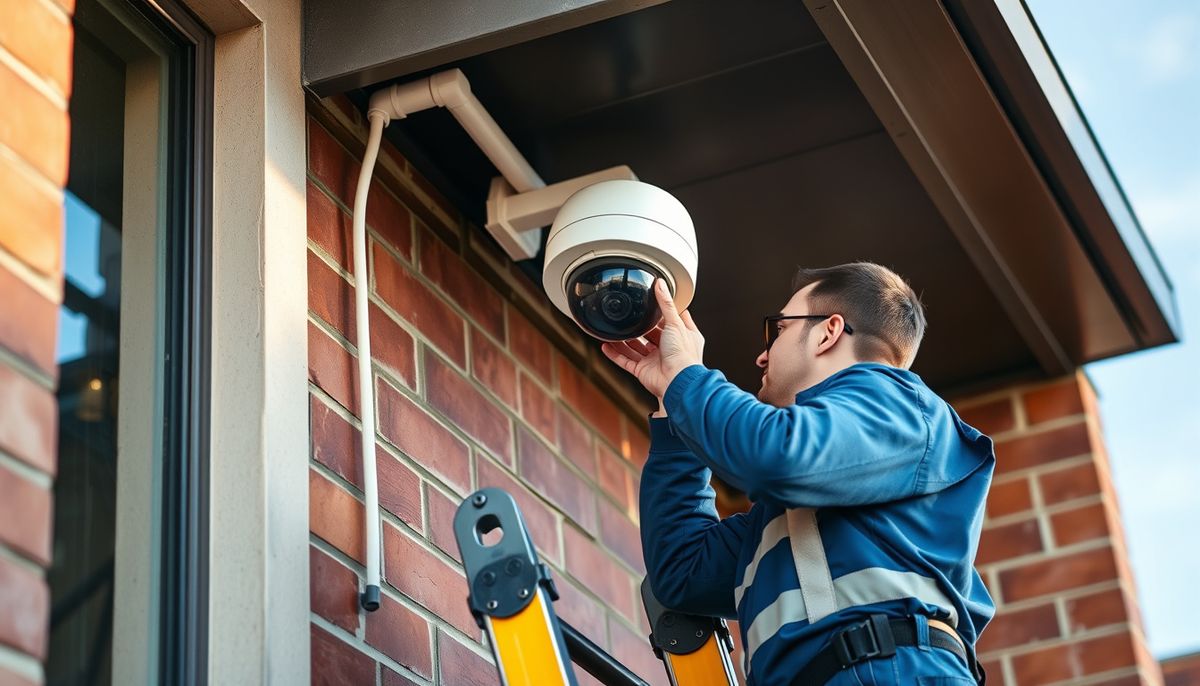
Good security camera placement starts with purpose, not camera count. Decide what each camera must achieve (spot a person, recognise them or identify them), then mount it where it can deliver that detail at the distance involved. For most Sydney homes, strata blocks and businesses, that means covering every entry, vehicle access point and high-value area with no gaps between views.
This guide comes from Unotel Security (UNOTEL Pty Ltd), a licensed NSW security and data cabling installer serving South-West Sydney, Macarthur and greater Sydney, NSW Master Security Licence ML 000111638, phone 02 4613 5840.
Plan security camera placement by detail level
The standard IEC 62676-4 sorts camera tasks into four levels known as DORI: detect, observe, recognise and identify. Each is measured in pixel density, meaning the number of image pixels across one metre of the scene. Axis Communications' guidance on the standard gives these targets:
| Task | What you can tell | Pixel density |
|---|---|---|
| Detect | Someone is there | 25 px/m |
| Observe | How many people, clothing | 63 px/m |
| Recognise | Same person seen before | 125 px/m |
| Identify | Who the person is | 250 px/m |
Lighting, lens quality and compression affect real results, so verify on site.
How many security cameras does a property need?
You need one camera for every zone that requires its own detail level, so the count comes from your site plan, not a package.
| Zone | Suggested goal |
|---|---|
| Front door, reception, intercom | Identify |
| Driveway, car park entry, roller doors | Recognise |
| Side passages, rear yards | Observe |
| Open car parks, fence lines | Detect or observe |
| Stock, cash and comms rooms | Recognise or identify |
What is the right CCTV camera height?
Around 2.4 to 3 metres is a commonly recommended outdoor height. Higher mounts are harder to tamper with and see more, but the added distance and steeper angle reduce facial detail. Put identification cameras lower and closer to doorways, and overview cameras higher.
Where do CCTV blind spots usually hide?
- Directly below each camera, so have cameras cover each other's mounting points.
- Behind pillars, bins, parked cars and growing garden beds.
- Into low afternoon sun on west-facing frontages, or backlit glass doors.
- Unlit areas at night.
NSW rules for workplaces and strata
- Workplaces: the Workplace Surveillance Act 2005 (NSW) requires at least 14 days' written notice to staff and visible signs, and bans cameras in toilets and change rooms.
- Strata: a lot owner needs owners corporation consent before fitting cameras on common property, governed by the Strata Schemes Management Act 2015. Many committees pass a by-law first.
- Audio: recording conversations falls under the Surveillance Devices Act 2007 (NSW), so most systems record video only.
The AS 4806 series is the Australian CCTV management and operation standard. Get legal advice for your specific site.
Printable site-walk plan for your cameras
- Sketch the site, marking every door, gate, driveway and lift or stair lobby.
- Give each zone a DORI goal.
- Stand at each proposed mount and check sightlines, sun and obstructions.
- Return after dark to check lighting.
- Pick a secure, ventilated spot for the NVR (network video recorder, the unit that stores footage) and map cable routes to it.
- Confirm approvals: staff notice, signage or strata by-law.
What a professional installation involves
- Design: zones, goals and camera positions agreed with you.
- Cabling: network cable to each camera, usually PoE (Power over Ethernet, carrying power and data on one cable), terminated and tested.
- Mounting and aiming: each camera set to its zone goal.
- Recorder setup: recording, user access and phone viewing.
- Handover: playback and footage export explained.
At Unotel, the same licensed team installs the security hardware and the telecom-grade cabling behind it, with no partner companies, so the network carrying your video is built to the same standard as the cameras. We bring more than 12 years of hands-on experience, working first across Campbelltown, Camden, Narellan, Oran Park, Leppington and Liverpool, and throughout the rest of Sydney. See our CCTV installation service.
Frequently asked questions
What pixel density identifies a face?
About 250 pixels per metre, based on IEC 62676-4 as summarised by Axis Communications.
Do NSW staff need notice before workplace CCTV?
Yes, at least 14 days' written notice under the Workplace Surveillance Act 2005 (NSW), plus signs.
Can a strata owner add a camera on common property?
Not without owners corporation consent. Check your scheme's by-laws.
Want your camera positions checked before you buy? Call Unotel Security on 02 4613 5840 for advice or a free site quote.
Sources
- Pixel density based on IEC 62676-4:2014 (Axis Communications white paper)
- Workplace surveillance and improperly obtained evidence (Corrs Chambers Westgarth)
- The Workplace Surveillance Act 2005 (NSW) (BrightHR Australia)
- Workplace Surveillance Act 2005 (NSW) Explained (Sprintlaw)
- CCTV Cameras in NSW Strata: Legal Guide (PBL Legal)
- NSW: Installing CCTV on common property without owner approval (LookUpStrata)
- CCTV in NSW Strata Communities (Netstrata)
- Australian CCTV Standard AS 4806 (Avigilon)
- Security Camera Placement Guide (DTiQ)
- How High Should You Mount a Security Camera? (AOSU)